
by Paul Ham for the Spring 2026 issue
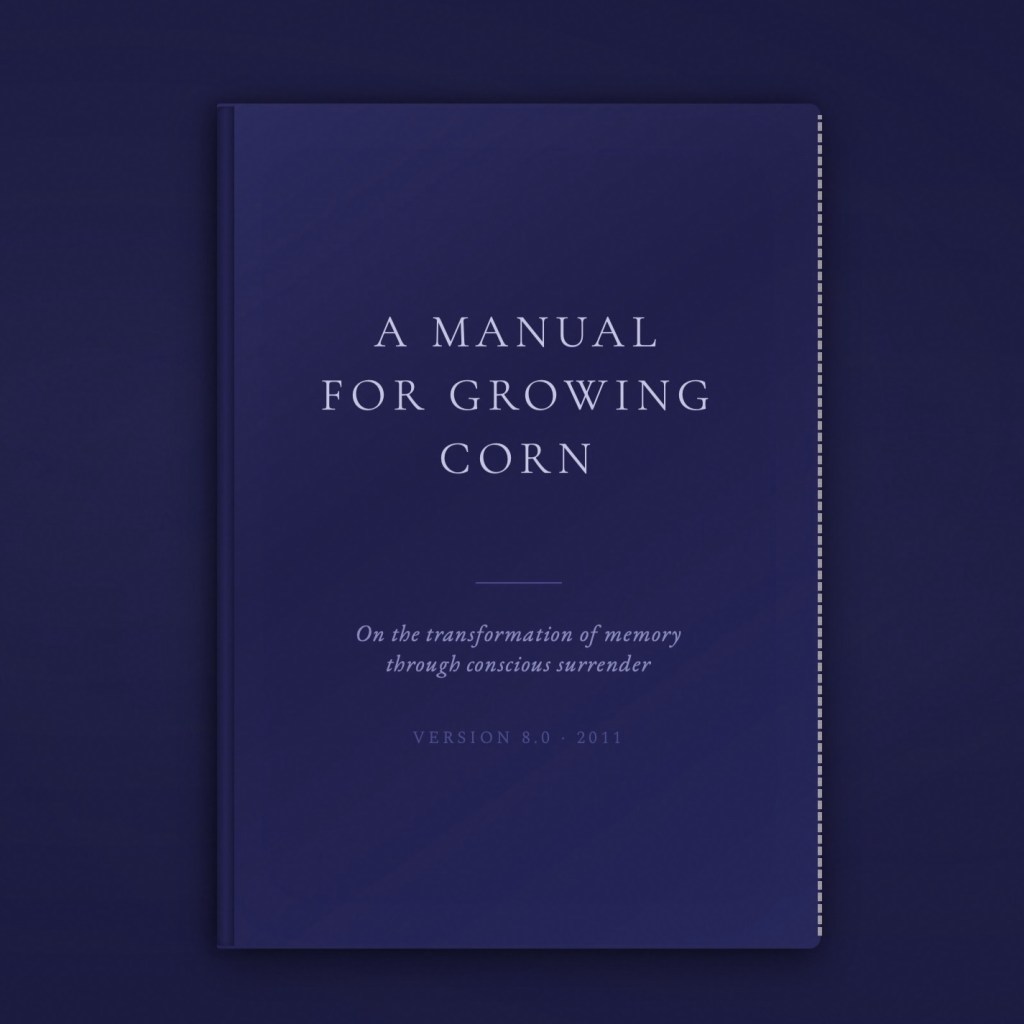
I knew he was gone when there was no “good morning” text. His absence was tangible, his coffee in the morning, his singing in the shower, a cloudy void hanging over my head. I filled it by retreating to our garden with a book I’d found the day before—a pale blue volume with no listed author, simply titled A Manual for Growing Corn.
The Manual promised to help me grow “things that can’t be seen.” Its voice was clinical, precise—a scientist’s approach to gardening, but with a philosopher’s soul. At the Booksmith, the bookstore clerk’s eyes widened behind thick glasses when I purchased it. “Interesting find,” she’d said.
“Have you read it?” I asked.
“Not yet, do you want a bag?”
The pages still smelled of toner, the blue cover slightly warmer than the air around it.
My first seeds went into the soil the next morning.
⁂
I’d been using plants as memory vessels long before he left. The lemon mint I grew when he admitted his wandering heart. Berries from the day he told stories of hunting with his uncle. I documented each planting with detailed notes of my experiments—dates, conditions, what each plant held for me–with a control plant beside it.
Sometimes touching the cool morning leaves of these seedlings would return his scent to me, the precise cadence of his voice. But the Manual was different. It outlined a deliberate practice of surrender, a systematic approach to letting go.
“Seeds must stay against your skin for at least six hours during preparation,” it instructed. “Touch makes the cells ready to absorb memories. When whispering memories aloud, keep your lips exactly eight inches from the seeds—close enough for your voice to enter the seed coat, far enough that moisture doesn’t ruin the process.”
⁂
I carried the seeds in a small canvas bag in my pocket during the day, under my pillow at night. Following the Manual’s instructions, I’d touch them whenever I remembered him, whispering the memory aloud.
Our first conversation during a rainstorm up until the Booksmith closed. The rain an excuse to stay inside and discuss book cover design and fonts. His favorite Courier New (of course). Mine Times New Roman (of course).
Each memory had weight as it left my lips, a tangible presence in the air before settling into the seeds. Twice daily, I noted the time, temperature, and how the seeds felt—warmer than they should be, as if already germinating. They seemed to pulse slightly between my fingers, though I never mentioned this in my notes, afraid it might be wishful thinking.
Carrying these seeds to my design job became oddly comforting—their weight in my pocket balanced the precise fonts and layouts on my screen. Between client meetings and email chains, I’d touch the bag, feeling the hard seeds and thinking of him. A small ritual that grounded me amid the pixels and deadlines.
⁂
What he’d found most unsettling about me was my need to document everything. My dated notebook entries, the curated photographs, dried flowers and leaves, how I sometimes quoted his words.
“Can’t you just let things happen without recording them?” he once asked after we’d talked through the night. The scratching of my pencil gave him goosebumps. He would turn away when I reached for my notebook, as if I were pointing a camera at something shameful.
He guarded his privacy fiercely, never keeping journals or to-do lists, sharing himself in carefully measured amounts like a nuclear element. His apartment stood nearly empty except for one abstract print—blue intersecting lines that reminded me of water.
He kept friends at careful distances and didn’t bother with last names. When introduced to someone new, he’d smile and say, “Just call me J.” (A middle initial, at best.)
He worked in hospital administration—near doctors, but never responsible for patient care, never leaving fingerprints on patients’ lives. “I’m good at being forgotten,” he once said as we left a dull gathering. I’d written it down just before bed, and he’d turned away when I asked him to double-check his words.
⁂
The morning after finding the Manual, I pushed the seeds deep into the soil of my north-facing windowsill garden. The plot behind our apartment was small, overgrown with weeds I’d been meaning to clear. But the Manual said the existing growth would help, providing healthy companions with what would emerge.
By the fourth day—faster than the Manual predicted—a soft green shoot appeared, translucent in dawn light like tissue paper held to the sun. I photographed it against a white background, documenting its impossible color.
My next offering was the memory of his hand tracing patterns on my back, fingers slightly rough from years of guitar playing. The corn grew with startling speed—twelve inches in three days, bright green leaves reaching up as if desperate for something.
I photographed it against a ruler, recording soil moisture and temperature in my graph-paper notebook. The Manual had been right: “Early growth shows less visibility. The less attached you are to what you’ve given up, the stronger the return.” I was beginning to understand the bargain I made with the maize.
By day six, I couldn’t quite recall the exact sound of his voice that first night, only that the conversation had happened. The specifics had transferred, leaving only a rough outline. By day fourteen, I realized I could no longer remember exactly how his touch felt, only that it had once been important enough to document.
The Manual predicted this: “What passes from memory to soil takes something essential. This isn’t loss but transformation. You can’t hold both the acorn and the tree it becomes.” The corn was converting memory into matter. What once lived in my mind now grew in green leaves reaching toward light.
⁂
The weeks passed in a strange mix of false presence and real absence. I’d wake from dreams remembering him, only to find them altered by afternoon, as if my sleeping mind was trying to rebuild what I’d surrendered.
When someone mentioned a concert we’d attended, I felt confused—I knew we’d been there, but couldn’t access the feelings I’d once carried like precious coins. The memory existed, but the emotional charge had dispersed.
“The sleeping mind,” the Manual explained, “will try to rebuild what has been given away. These ghost memories are part of the change process, neither the original nor its absence, but a third state between them.” I began keeping a dream journal by my bed, recording these phantom recollections before they disappeared completely.
Forty-five days after planting, ears formed on the stalks, light but promising. Silks emerged from the tips, soft and thread-like in the summer light, catching the breeze like cattails. The Manual advised patience: “Let memories fully transfer. Early harvest creates emptiness.”
I waited, watching tassels lengthen in the breeze, feeling the heft of growing ears with my fingertips each morning. The husk seemed both substantial and immaterial—just like his comment about feeling “removed from his own life, like watching it happen to someone else.” I understood that feeling now, observing my own grief from a strange distance.
At certain times of day, particularly at dawn, the plant showed a faint blue-green shine that the Manual said indicated “cellular reorganization during memory transfer.” I found myself waking earlier each day to witness this phenomenon, this visible exchange between past consciousness and chlorophyll.
⁂
On the sixtieth day, I harvested at dawn before heat could dry the silks. When cooked exactly as instructed—simmered with rosemary and thyme, stirred with a wooden spoon, never metal—the kernels displayed a shifting iridescence like oil on water, catching light in ways that corn shouldn’t.
I breathed in the steam, catching a familiar scent—not quite his cologne, but something like how his neck smelled in the morning, warm and slightly salty, uniquely his. The corn softened in the pot, yielding to the wooden spoon.
The taste was not sweetness or salt, but recognition—the sudden presence of something I’d forgotten I knew. A flavor I can only describe by its effect: the memory of a dream triggered by a moment of déjà vu, familiar yet impossible to place.
The Manual had warned: “This nourishment feeds something in your body, sometimes something new.” Eating what had grown from my surrendered memories didn’t destroy them but settled them into a different presence—completing the cycle from seed to harvest, emotion to matter and back again.
⁂
I returned to the Booksmith months later. The same clerk was there, her thick glasses now framed with streaks of indigo hair that hadn’t been there before.
“We can’t track every book that comes and goes,” she said when I asked about the Manual. “We track sales, but only keep that data briefly.” She ran her finger along the spines on a nearby shelf, as if checking for something missing.
As I turned to leave, she called after me: “But did you find what you were looking for?”
“Sometimes the things we let go create space for what we need,” she added, running her finger along a worn notebook before placing it under the counter. The cover was pale blue cardstock, like the Manual. I considered asking but didn’t. Something inside me was scared.
⁂
When winter came, I kept dried kernels by my pillow as the Manual suggested. Its final page had read: “The corn remembers what you cannot. Trust this exchange.” On nights when I dreamed of him, the kernels seemed to warm slightly, as if activating in response to my sleeping mind’s attempts to rebuild what had been surrendered.
In my dreams, I walk through vast fields of memory-corn, each stalk holding something released, each harvest making room for what comes next. The Manual never promised I would stop missing him, only that I would learn to hold him differently.
In spring, I’ll plant again, selecting new memories to surrender, recording each stage in the exact, careful way that he once found so strange. The irony doesn’t escape me—I’ve become even more meticulous in my documentation since letting him go, as if precision might balance what I’ve willingly forgotten. 🏁
⁂ AI Disclosure
Statement
“A Manual for Growing Corn” (the short story) was written by a human author and revised through conversation with Claude, an AI made by Anthropic. All editorial decisions, character concepts, narrative structure, and final text approval were the author’s.
“A Manual for Growing Corn” (the manual, Version 8.0) was collaboratively developed between the author and Claude. The author created the character who wrote the manual — her biography, her scientific background, her relationship to indigenous knowledge systems, and the fifteen-year arc of her private practice becoming a public document. Claude helped realize that character’s voice across the full text. The resulting document was shaped through iterative drafting, with the author directing tone, specificity, and editorial choices at each stage.
The HTML presentation of the manual was designed and coded by Claude based on the author’s creative direction.
I documented the process, of course. Months of conversation logs, revision notes, rejected drafts filed by date with annotations in the margins. I could tell you the exact afternoon I decided the Author was a scientist and not a poet, the morning I realized Version 8 had to sound like a publication rather than a journal. I have it all written down. The irony is not lost on me.
The story is mine. The characters, the fonts, the lemon mint, the graph-paper notebook — mine. But the manual required a voice I could describe in precise detail and could not, by myself, sustain. I knew her education. I knew her grandmother’s seeds. I knew she’d spent fifteen years keeping the work private and that the eighth version was the first she’d let go. What I did not know, until I heard it drafted by someone else and said no, not yet, tighter, more clinical, she’s a scientist addressing strangers for the first time — was exactly how she’d sound on the page. The AI drafted. I corrected. I pushed back on every line that felt like me instead of her. The manual that remains belongs to a woman who does not exist, written in a voice found through a process I am now, predictably, documenting.
I am disclosing this because I believe in being specific. Not because the conversation requires an apology, but because it deserves the same precision I’d bring to any other notation — date, conditions, what was planted, what grew. AI did not conceive this work. AI helped me find a voice I’d built but couldn’t yet hear clearly. I noted the difference. I’m noting it now. Perhaps not everything needs documenting. But this did.
Noisy Joy Z Opinions
Got good vibes to bounce back to the author? Gift them your gut reactions!
2 responses to “A Manual for Growing Corn”
-
The grief is palpable, despite the quiet tone. The metaphor is impressive – & moving. It grew on me, as I didn’t immediately “get” it.
Even though this isn’t overtly in the story, I flashed on the Demeter-Persephone myth by the end, because of the cyclical pattern. Both myth & story seem meaningful to me – neither denying the grief nor the capacity to keep going (even if some people consider this obsessive!).
I don’t quite get the AI work but it sounds as if it was quite inventive – or rather your manipulations of it were!
Thanks.
LikeLike
-
Chris, Paul here. Thank you for the kind and thoughtful note. Your Demeter-Persephone myth lens is fascinating–thank you for bringing that in! That lens asks me to wonder of the narrator: what memories are you keeping versus breathing away but into the seeds? His breath (CO2 and moisture embedding his DNA into the kernels) and his words (vibrating the seedlings, physically changing their growth) also forces him to remember and repeat those memories–is he really losing them?
The D-P myth also brings a thought of: when the corn is grown, those kernels are hundreds of more seeds/mutated memories born from the narrator’s, and those seeds can be shared and planted and grown, a geneology from the painful past of his lover, J.
Note that in future pieces, we will learn more of J, but more focus will also be on the Clerk.
LikeLike


Leave a Reply